





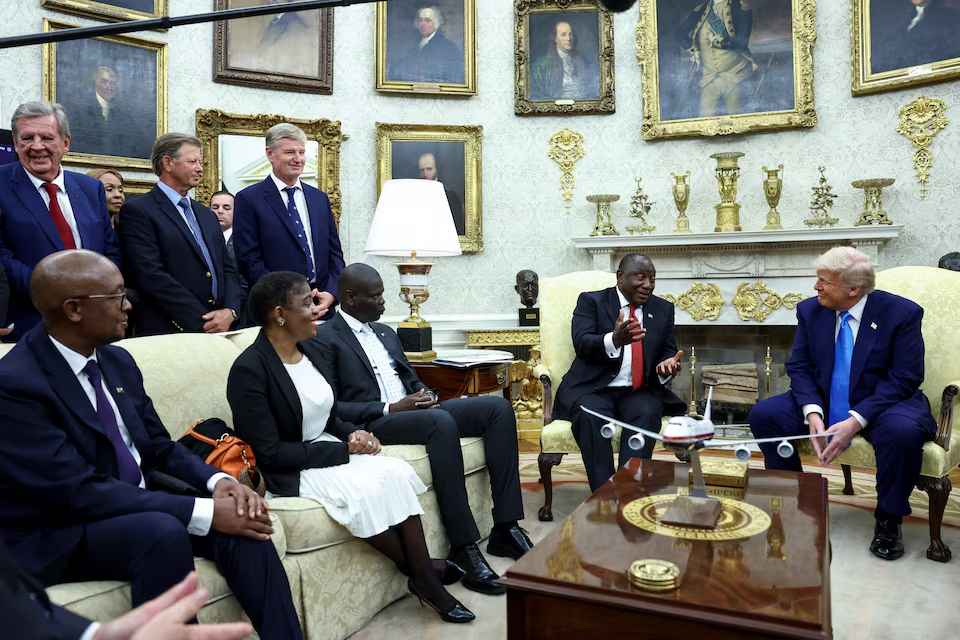
Keypoints:
- Trump confronts Ramaphosa with debunked claims
- South Africans question value of US visit
- Govt defends Ramaphosa’s composed response
SOUTH Africans have reacted with anger and disbelief after US President Donald Trump used a high-stakes meeting with President Cyril Ramaphosa to revive discredited claims of a ‘white genocide’ in South Africa.
During the May 21 meeting at the White House, Trump repeatedly raised concerns about alleged attacks on white farmers, overshadowing South Africa’s agenda for strengthening diplomatic and trade ties. According to Reuters, the meeting left many in South Africa questioning whether the visit had been worth the political cost.
‘We know there’s no white genocide. For me, it was a pointless exercise,’ said Sobelo Motha, a trade union member in Johannesburg, reflecting a widespread sentiment among South Africans.
Frustration mounts over missed opportunity
Ramaphosa had included prominent white South Africans, including billionaire Johann Rupert and leading sports figures, in his delegation in a bid to reset relations with Washington. But Trump dominated the conversation with misleading material—playing videos and referencing far-right articles supporting the ‘white genocide’ theory.
‘He didn’t get Zelenskyed, but it still felt like a humiliation,’ wrote Rebecca Davis in South Africa’s Daily Maverick, referencing Trump’s public berating of Ukraine’s President earlier this year.
Many South Africans saw the encounter as a distraction from real issues, with some questioning why their leader subjected himself to the meeting at all.
Pretoria defends Ramaphosa’s calm response
South Africa’s foreign ministry spokesperson Chrispin Phiri defended Ramaphosa’s approach, telling Reuters the president chose calm over confrontation.
‘It’s not in the president’s nature to be combative,’ Phiri said. ‘He looks at issues calmly, matter-of-factly. That’s what we expect of our presidents.’
Rupert, who attended the Oval Office meeting, reportedly pushed back gently, telling Trump that violent crime in South Africa affects all races, not just white citizens.
Fringe theory rejected by mainstream South Africans
Though extremist rhetoric persists in some far-right circles, South Africans across racial and political lines have dismissed Trump’s claims.
White South Africans account for less than 8 percent of the population but still control about 75 percent of private land, according to government data. South Africa’s annual murder rate exceeds 20,000, and the vast majority of victims are Black.
Even data from the Afrikaner farmers’ union TLU-SA shows an average of 40 white farmers killed per year since 1990—less than 1 percent of all murders.
‘The idea of white genocide has been strategically amplified by far-right actors abroad,’ journalist Pieter du Toit told Reuters. ‘They’ve fed it into the American right-wing ecosystem for years.’
‘It’s all out of context,’ says Sandton resident
On the streets of Sandton, Johannesburg’s financial hub, South Africans said the US president’s fixation was both insulting and ignorant.
‘The violent crime issue should be looked at in its entirety,’ said Owen van Roen, a commodities trader. ‘This genocide talk is totally out of context.’
The White House meeting follows months of tension between Washington and Pretoria. Trump has cut US aid, granted refugee status to Afrikaners, and publicly criticised South Africa’s genocide case against Israel.
Despite the controversy, officials in Pretoria say the meeting offered a chance to engage—even if the outcome wasn’t what they’d hoped.









