





Keypoints:
- Two people died during protests against a proposed Ebola facility in Nanyuki
- Kenya’s High Court has extended a suspension of the project
- President William Ruto defended the agreement with the United States
TWO people have died following protests in Kenya’s central town of Nanyuki against a proposed US-backed Ebola isolation facility, deepening a national dispute that has already prompted court intervention and heightened concerns over public health safeguards.
The deaths mark a significant escalation in public opposition to the proposed treatment centre. The controversy has triggered legal challenges, divided public opinion and raised broader questions about public health safeguards, government transparency and Kenya’s role in responding to international health emergencies.
Demonstrations descend into violence
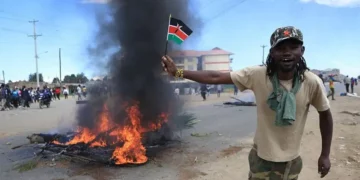
Hundreds of residents marched through Nanyuki on Monday, blocking roads and burning tyres as anger mounted over the proposed facility. Police responded by firing tear gas to disperse crowds.
Local community leader Patrick Wahome said that one of the victims was allegedly shot while returning home after closing his business.
The second victim was reportedly brought to Nanyuki’s main hospital by military personnel and was declared dead on arrival. The circumstances surrounding his death remain unclear.
Hospital sources indicated that both bodies were transferred to the facility’s morgue and appeared to have sustained gunshot wounds. One reportedly suffered a chest wound while the other had a shoulder injury.
Authorities have not publicly commented on the deaths. A police spokesman quoted by Reuters said he was not aware of any fatalities linked to the demonstrations.
By Tuesday morning, calm had largely returned to the town, although a heavy security presence remained in place.
Proposed facility sparks public concern
At the centre of the dispute is a planned 50-bed Ebola isolation and treatment facility to be established at Laikipia Airbase.
The centre would reportedly be staffed by US medical personnel and used to treat American citizens affected by the ongoing Ebola outbreak in the Democratic Republic of Congo.
Kenya has not recorded any Ebola infections, and government officials have repeatedly stated that the country maintains robust disease surveillance and response systems.
However, opponents argue that hosting such a facility could expose nearby communities to unnecessary risks and potentially increase concerns about cross-border transmission.
The Democratic Republic of Congo has experienced multiple Ebola outbreaks over the past decade, prompting governments across East and Central Africa to strengthen disease monitoring and emergency preparedness measures.
The debate comes as African countries continue investing in public health resilience following lessons learned from recent disease outbreaks across the continent.
High Court extends suspension
The proposal has also encountered legal obstacles.
Last week, Kenya’s High Court temporarily suspended the opening of the facility after a rights organisation filed a petition alleging that the project posed serious risks to public health.
On Tuesday, the court extended the suspension order and directed the government to disclose further details regarding the facility’s operations, safety measures and oversight arrangements.
The ruling followed reports that aircraft activity had continued at Laikipia Airbase despite the court’s earlier intervention. Security analysts and observers have suggested that preparations linked to the project may still be ongoing, although officials have not confirmed those reports.
Ruto defends US partnership
President William Ruto addressed the issue publicly for the first time on Monday, defending the arrangement with Washington.
The president said Kenya had agreed to support US efforts to manage the Ebola outbreak as part of a long-standing bilateral partnership.
According to Ruto, the request was made by US President Donald Trump and formed part of broader cooperation between the two countries.
Ruto insisted that the government had deployed extensive safeguards to protect public health and urged Kenyans not to politicise the issue.
He also criticised what he described as reckless public commentary surrounding the proposal and maintained that authorities were acting responsibly.
‘We are a responsible government. We know what we are doing,’ Ruto said.
Health groups remain opposed
Opposition to the project extends beyond local residents.
Kenya’s doctors’ union and several public accountability groups have expressed concerns over the facility, arguing that the government has not adequately addressed questions about risk management and community safety.
Health advocates are calling for greater transparency regarding containment procedures, emergency response plans and independent oversight before any facility becomes operational.
For now, the future of the proposed Ebola treatment centre remains uncertain as court proceedings continue and public debate intensifies.
As Kenya awaits further government disclosures, the controversy has evolved into a wider national conversation about public health policy, international partnerships and public trust in state institutions.


