Keypoints:
- Rare Nungua funeral revives ancient Ga rites
- Artistic coffins reshape burial practices
- Pallbearer choreography led by Aidoo
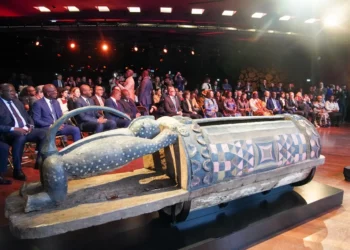
THE funeral of Nii Agbetekor, the supreme military leader of Nungua in Ghana’s Greater Accra Region, was a spectacle two years in the making — an epic cultural event not seen in over two decades. When the day came in November 2024, it featured a lion-shaped coffin that briefly caught fire, military palanquins shaped like animals and plants, and crowds filling the streets in ceremonial dress.
As reported by CNN, this wasn’t just a farewell — it was a celebration of legacy, identity and artistry, rooted in Ga tradition and revived through research and ritual.
Ancient rites meet modern spectacle
Swiss anthropologist Regula Tschumi was there to document the rare occasion. Her two decades of work studying Ghanaian funerary traditions had come full circle — unknowingly, her own published research had been used to guide organisers in reviving the long-dormant rituals for Agbetekor’s funeral.
Tschumi’s new book, Buried in Style: Artistic Coffins and Funerary Culture in Ghana, showcases photographs from 2004 to 2024, capturing Christian and traditional funerals, coffin dancers, and the evolution of ‘laying out’ ceremonies. Most strikingly, it celebrates the iconic figurative coffins handcrafted by local artisans.
These coffins — shaped like pineapples, football boots, crabs, or whale sharks — are deeply personal, though the deceased rarely choose their form. ‘It’s often the family who decides,’ Tschumi told CNN, ‘sometimes the artist brings the idea, or they use a photograph.’ The symbolism reflects the person’s life, trade, or aspirations.
The man who made funerals dance
Much of the cultural shift in Ghanaian funerals can be traced to Benjamin Aidoo, the man behind the globally famous ‘coffin dancers’. His company, Nana Otafrija Pallbearing and Waiting Services, has redefined mourning by blending choreography with tradition. What started with a few steps to the rhythm of traditional drums evolved into a full-blown performance art.
‘We used to march solemnly and people cried. I thought, why not celebrate?’ Aidoo told CNN. His routines — complete with uniforms and rehearsed moves — became internet sensations in the pre-Covid era, creating a business that at its peak employed nearly 100 people.
Aidoo’s performances, however, are more than just viral entertainment. They represent a new expression of grief and joy, drawing from centuries-old cultural values while captivating global audiences. Tschumi credits him with opening doors to otherwise restricted ceremonies.
Coffins as cultural artefacts
While funeral coffins in the West are often austere, Ghanaian coffins are vibrant declarations. A crab for a builder, a truck for a driver, even a blue teapot for a traditional priest. According to Tschumi, coffin makers are increasingly attracting international interest, selling their work to galleries and museums.
These designs are rooted in Ga traditions of figurative palanquins, once used to carry chiefs. The craft is still largely manual, taking five to 10 days per coffin. ‘They’re not expensive by Western standards,’ said Tschumi, making them attractive exports.
Yet access to funerals remains a delicate issue. Many rituals, particularly those involving chiefs and priests, are kept secret. Some chiefs are buried at night; others are laid under family homes, a practice restricted during colonial times but believed to persist in some communities.
Mourning as memory and performance
Tschumi’s work has also uncovered another tradition known as ‘laying out’ — elaborate night vigils where the deceased are dressed, positioned upright or seated, and sometimes ‘re-posed’ during the evening. One such vigil involved a priestess whose body was moved multiple times and adorned with ritual white paste, replicating her shrine.
These ceremonies aren’t only for leaders. Tschumi documented a 2022 vigil for a man posed with a beer and barbecue — sausages sizzling beside his lifeless form as mourners partied around him.
Her documentation has even influenced new customs. Chiefs in Ghana’s Central Region, after seeing Tschumi’s earlier book, began requesting figurative palanquins of their own — a rare example of scholarly work shaping living tradition.
Today, as funeral culture in Ghana blends reverence, resistance and reinvention, Tschumi’s photographs remind the world that how we say goodbye says everything about how we choose to remember.